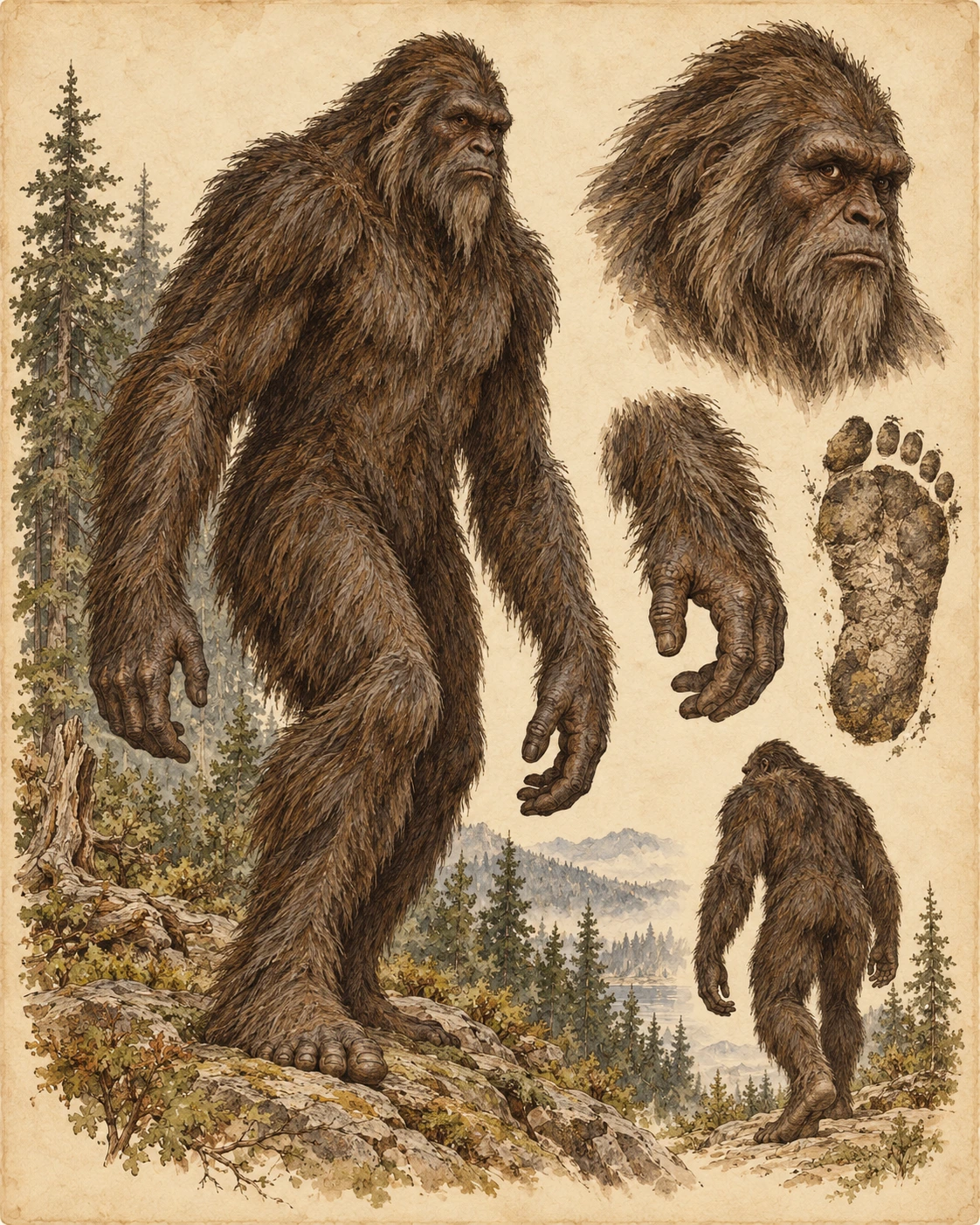
Bigfoot, also known as Sasquatch, is a large, hair-covered figure associated with the forests of western North America. Oversized footprints, fleeting encounters, and an apparent ability to disappear into the woods define the familiar image. In MetaZoo, that connection to the forest becomes part of the creature’s identity on the cards.
- Associated location
- The Pacific Northwest and neighboring forested regions, especially northern California, Oregon, Washington, and British Columbia. [1]
- Defining modern reports
- The 1958 northern California footprint stories and the 1967 Patterson–Gimlin film helped bring Bigfoot to a national audience. [2]
- Reported appearance
- A tall, upright, hair-covered figure with apelike features and unusually large feet. Descriptions vary. [1]
- Recurring folklore
- Remote forests, enormous tracks, brief sightings, and an elusive presence just beyond clear observation.
The legend
Sasquatch and the forest
The name Sasquatch derives from Sasq’ets, a Halq’emeylem word from southwestern British Columbia. Accounts of large, hairy beings also occur in the traditions of different Indigenous communities. Those traditions have their own names and meanings; treating all of them as identical stories about a single undiscovered animal loses that distinction. [1]
The familiar modern Bigfoot is often portrayed as a forest-dwelling figure that walks upright and avoids people. Its footprints give an unseen presence something tangible to leave behind: a shape in mud, a trail across a logging road, or a plaster cast that can be carried away.
The footprints that spread the name
In 1958, logger Jerry Crew brought attention to oversized footprints found near a northern California worksite. Reporting by the Humboldt Times helped popularize the name Bigfoot, and the story spread beyond the region. In 2002, Ray Wallace’s family attributed the famous tracks to wooden feet used to make a hoax. That claim concerns those particular tracks; it does not account for every story grouped under the Bigfoot name. [2]
The Patterson–Gimlin film
On October 20, 1967, Roger Patterson and Bob Gimlin filmed a large, apparently hair-covered figure at Bluff Creek, California. The short sequence became the best-known moving image associated with Bigfoot. Its authenticity remains disputed, and its familiar walking pose has become a visual shorthand for the creature. [2]
Footprint casts, witness reports, and films are important objects in the history of the legend, but they do not establish Bigfoot as a scientifically confirmed species. The Arizona State Museum preserves alleged footprint and handprint casts as historical artifacts while distinguishing that cultural value from proof of the creature’s existence. [3]
Bigfoot in MetaZoo
Cryptid Nation
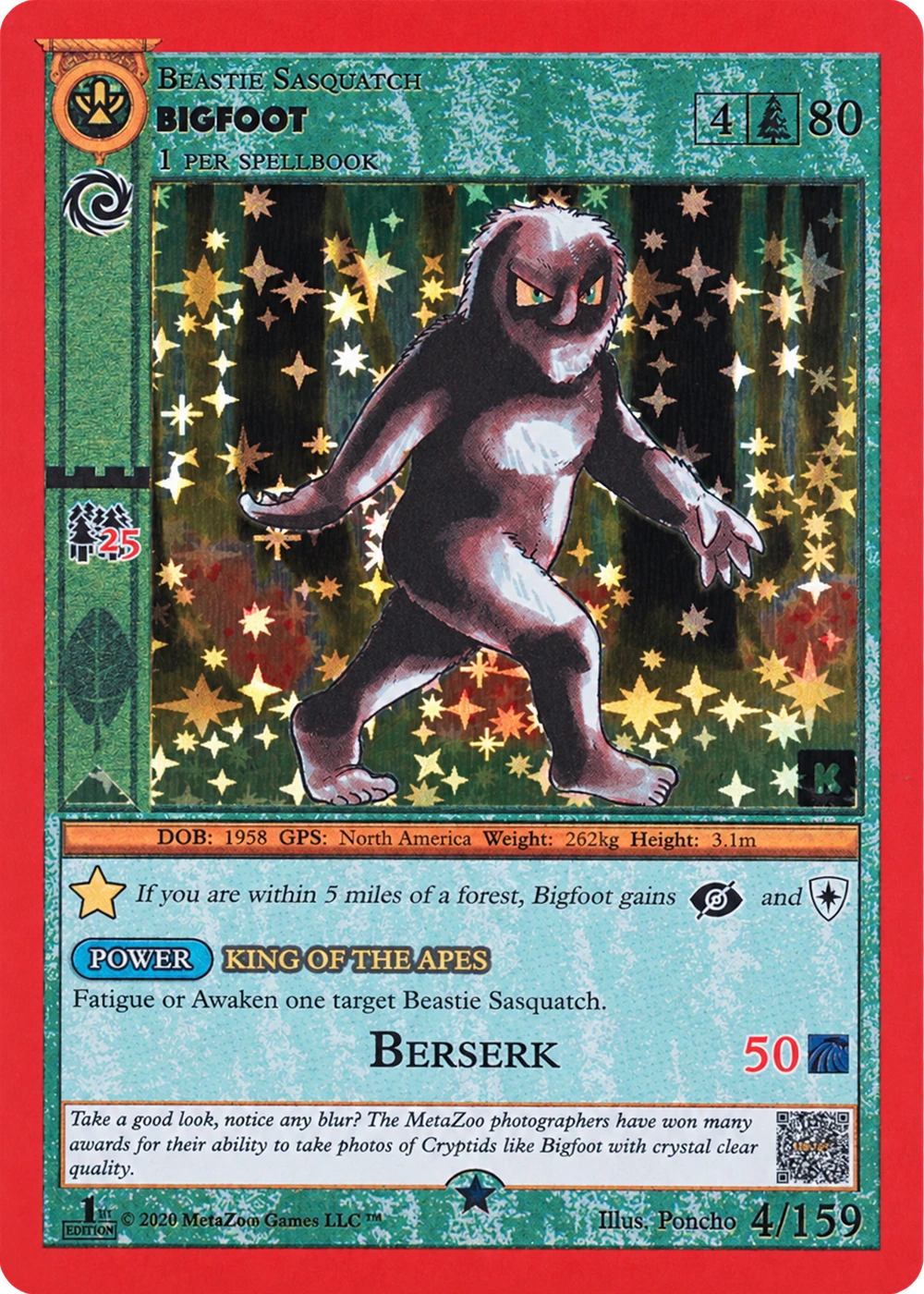
Bigfoot, 4/159, appears in the original Cryptid Nation set as a Forest-aura Beastie Sasquatch. Its fourth-wall effect gives it Invisible and Magiproof when the player is within five miles of a forest. The association is direct: the surroundings that make Bigfoot elusive in folklore also make it harder to confront in the game. [4]
The card’s King of the Apes power affects a Beastie Sasquatch, giving the tribe a mechanical connection as well as a shared subject. For identification, distinguish the card’s set number from its edition and holo printing. [4]
Cryptid Nation · Kickstarter · Full Holo
Wilderness
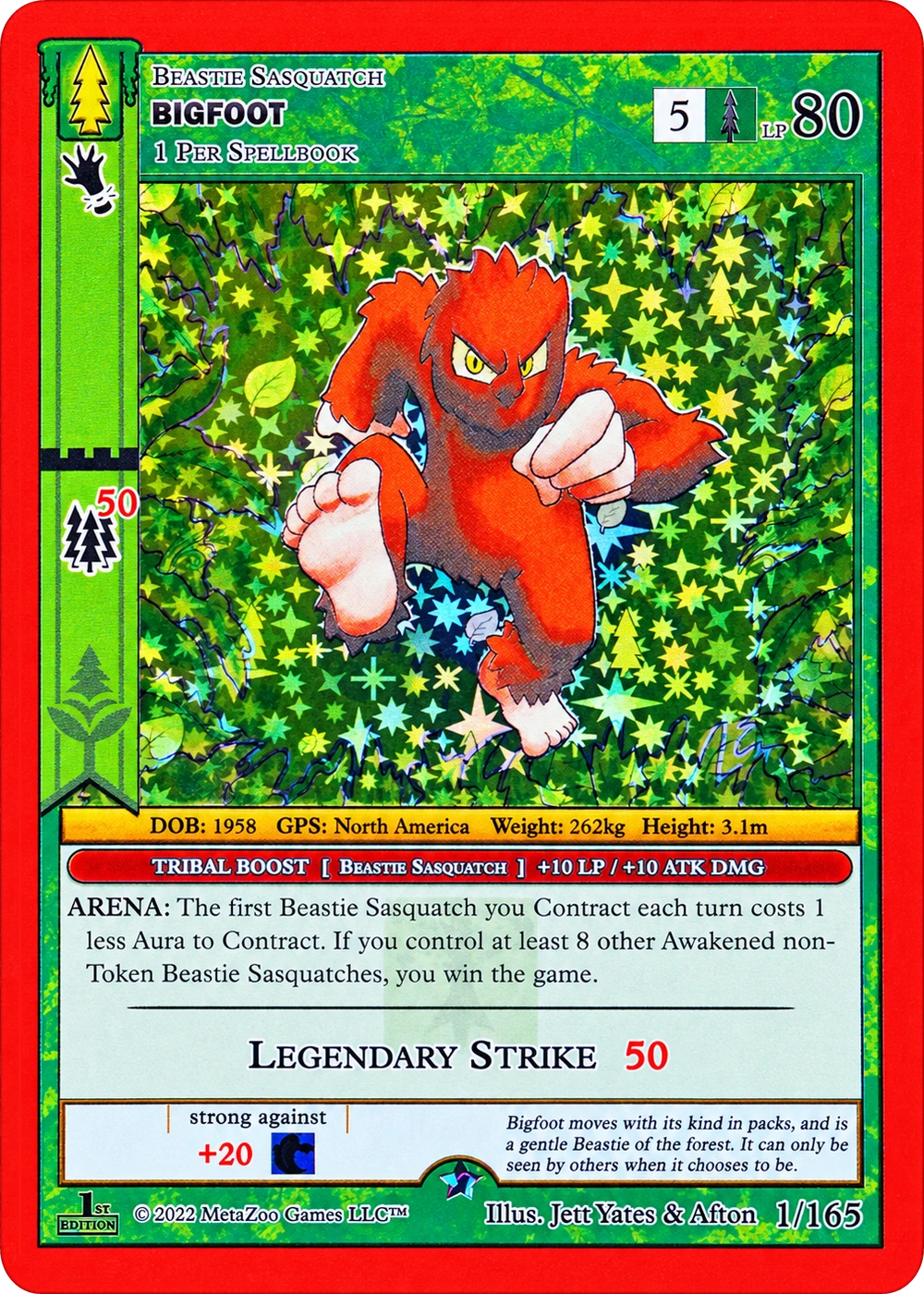
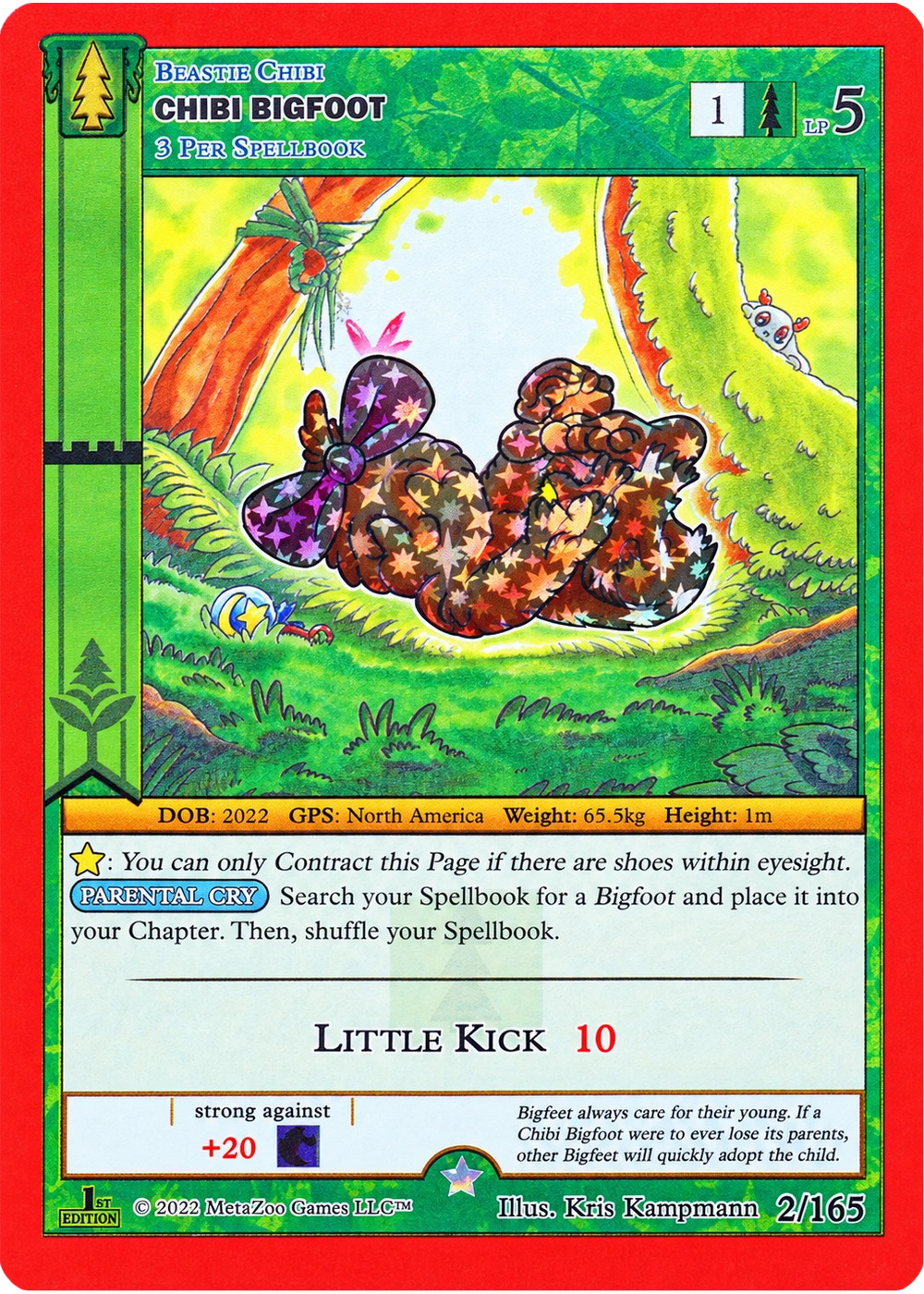
Wilderness Bigfoot, 1/165, gives the creature another core-set appearance. It is one of the set’s Wild Seven: cards with a Full Holo printing but no Reverse Holo or Non-Holo version in the First Edition core set. Chibi Bigfoot, 2/165, appears alongside it in a smaller, playful interpretation, with its own printing choices. [5]
Wilderness · Full Holo
Wilderness · Reverse Holo
The two cards are separate entries, rather than different printings of one card. Their shared creature provides a useful example of how MetaZoo can shift between imposing cryptid artwork and a more whimsical treatment.
A related interpretation in UFO
Alien Bigfoot, 41/165, carries the name into UFO’s extraterrestrial setting. It is worth recording as a related card when defining a Bigfoot collection, while keeping its distinct name and set entry clear. The UFO set list shows its available First Edition printings. [6]
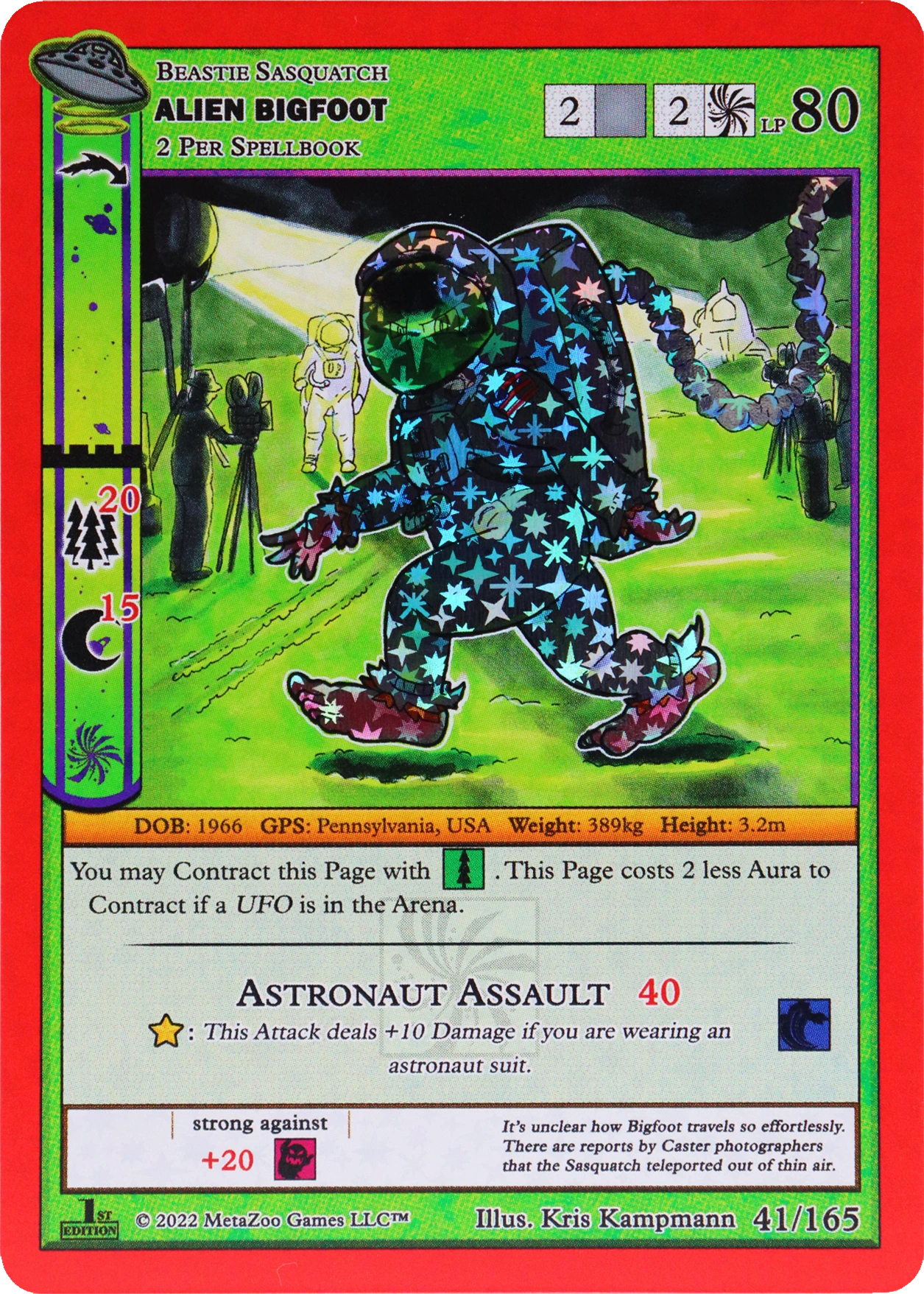
UFO · Reverse Holo
Card reference
| Release | Card | Number | Reference note |
|---|---|---|---|
| Cryptid Nation | Bigfoot | 4/159 | Forest-aura Beastie Sasquatch; identify edition and printing separately. [4] |
| Wilderness | Bigfoot | 1/165 | Full Holo only in the First Edition core set. Set list |
| Wilderness | Chibi Bigfoot | 2/165 | Separate card with Full Holo, Reverse Holo, and Non-Holo printings. Set list |
| UFO | Alien Bigfoot | 41/165 | A related interpretation; Reverse Holo and Non-Holo printings. Set list |
When identifying a card: record the complete name, set, edition, collector number, and printing. Bigfoot, Chibi Bigfoot, and Alien Bigfoot are distinct card entries.
Browse Beastie Files → Browse set lists →
Sources and further reading
- The Oregon Encyclopedia: Bigfoot (Sasquatch) legend, by Robert Walls; a project of the Oregon Historical Society.
- PBS Monstrum: Uncovering the Enigma: Sasquatch Sightings—the 1958 reports, later hoax claims, and the Patterson–Gimlin film.
- Arizona State Museum: Tracking the Legend of Bigfoot—the museum’s alleged footprint and handprint casts and their historical context.
- Card Game Collector: Cryptid Nation Bigfoot—card image, number, aura, tribe, and rules transcription.
- MZCodex: Wilderness First Edition set list—card scans and printing references.
- MZCodex: UFO First Edition set list—Alien Bigfoot card scans and printing references.